AI for healthcare operations: what is actually deployable today
In short
The AI reaching production in healthcare today is overwhelmingly operational rather than diagnostic: patient intake and scheduling, insurance verification, prior authorisation and denial management, worklist prioritisation, remote-monitoring triage, and clinical documentation — all areas where a human reviews the output and the error cost is recoverable.
Ask most people what AI in healthcare means and they will describe a model reading a scan and making a diagnosis. That work is real and it is heavily regulated, slow to approve, and narrow in scope.
Meanwhile, the AI that is actually going live in clinics and hospitals sits one layer down, in the administrative machinery — and that is where the return currently is, because the administrative burden is enormous and the error cost is recoverable.
The deployable line in healthcare AI is drawn by consequence, not by difficulty. Where a human reviews the output before it matters, systems ship. Where the model is the last decision, they do not.
Intake, scheduling, and verification
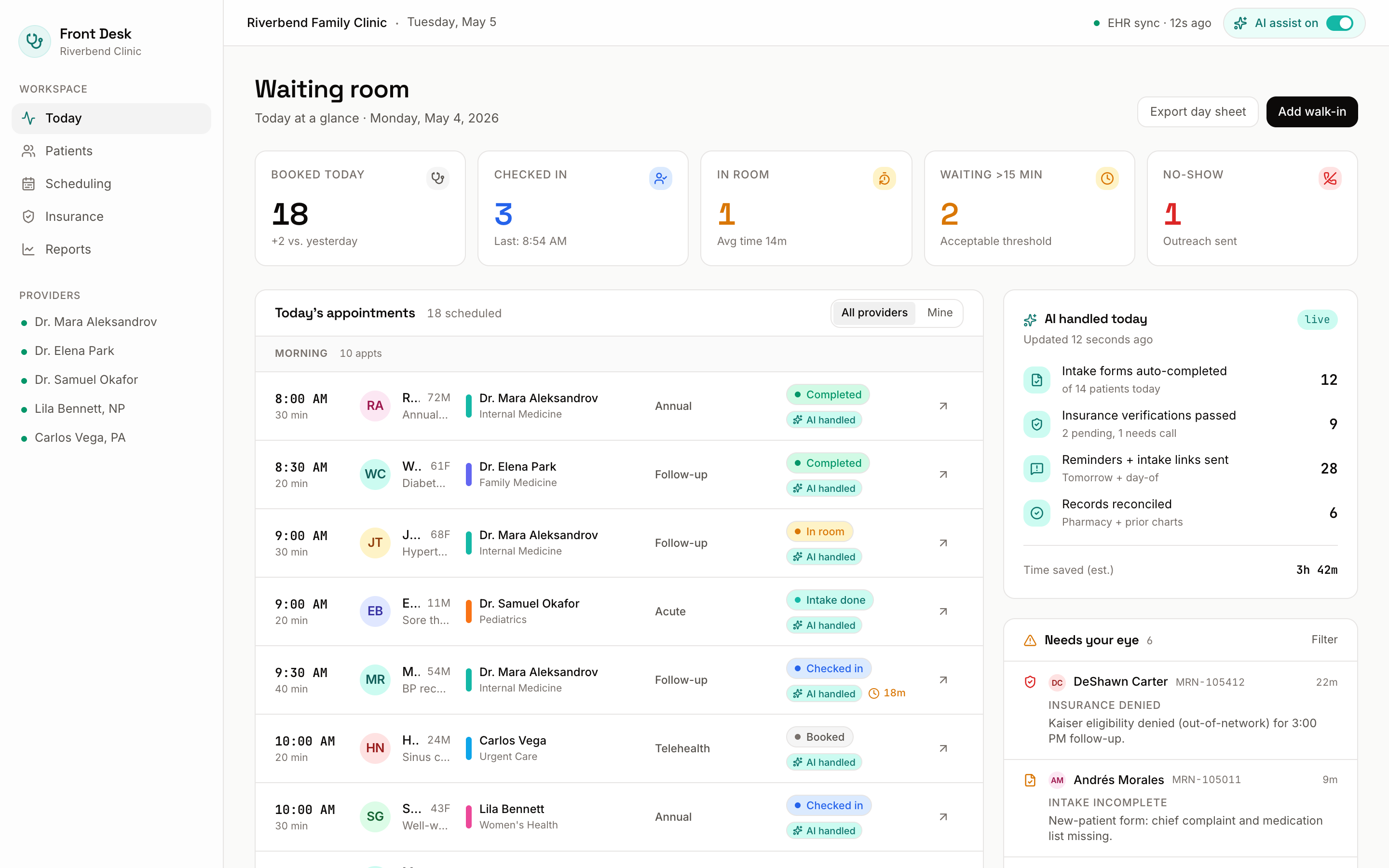
Before a patient is seen, a clinic collects history, confirms coverage, and finds a slot. It is high-volume, rule-heavy, phone-bound work, and it is where staff time disappears.
This is a natural fit: structured extraction from unstructured input, constrained decisions, and a human at the desk who catches anything odd before it matters. Our Patient Front Desk works exactly here — automating intake, scheduling, and insurance verification before the patient walks in — and Focuscare covers the same span for physiotherapy practices, from onboarding through to generated notes and follow-up scheduling.
Prior authorisation and denial management
Revenue cycle is arguably the strongest operational case in healthcare AI, because the work is document assembly against payer-specific rules and the feedback signal — paid or denied — is unambiguous and arrives reliably.
- Assembling an authorisation packet is retrieval plus templating against a known payer rule set.
- Predicting a denial before submission is a supervised problem with abundant labelled history.
- Drafting an appeal is generation grounded in the denial reason and the clinical record.
- Every outcome is a labelled training and evaluation example, automatically.
PriorPilot is our build in this space — auto-assembling and submitting authorisations, predicting denials before submission, and drafting the appeal. The pattern generalises to any workflow where a payer or regulator returns a structured verdict.
Worklist prioritisation, which is not diagnosis
There is an important distinction between a model that says "this study shows a bleed" and one that says "read this study before the other forty in the queue". The second does not make a clinical claim. It reorders work, a clinician still reads everything, and the failure mode is a delay rather than a missed diagnosis.
That reframing is what makes it deployable. ScanQueue applies it to radiology — flagging suspected critical findings on incoming CT, MR, and X-ray studies and ordering every read by acuity and service level. VitalLoop applies the same logic to remote patient monitoring, triaging home vitals into a prioritised care queue and drafting outreach.
Clinical documentation
Ambient documentation has moved fastest of all, for a structural reason: the clinician reads and signs the note. There is a mandatory human checkpoint built into the existing workflow, so the system produces a draft rather than a record.
The lesson generalises well beyond healthcare. Where a review step already exists in the process, AI adoption is dramatically easier, because you are not asking anyone to trust the system — you are asking them to edit instead of type.
What consistently does not ship
- Anything that is the final clinical decision with no practitioner in the loop.
- Systems that need data the organisation does not actually hold in structured, accessible form — the constraint is almost always integration, not modelling.
- Anything that cannot explain itself well enough for a clinician to disagree with it. An unexplainable recommendation is an unusable one.
- Deployments whose data path was not resolved before the build. Where inference may happen is an architectural decision — see private LLM deployment.
Where to start
Pick the workflow with the highest volume, the clearest existing review step, and an unambiguous outcome signal. In most provider organisations that is revenue cycle or front-desk operations, not clinical decision support.
Then scope it as a single repeated decision rather than a capability — the method in how to scope an AI project applies directly. More of our healthcare work is on the healthcare AI page.
Frequently asked questions
Short answers to the follow-ups this piece tends to raise.
What are the most deployable AI use cases in healthcare?
Operational rather than diagnostic ones: patient intake and scheduling, insurance verification, prior authorisation and denial management, worklist prioritisation, remote-monitoring triage, and clinical documentation. All of them have a human reviewing the output before it matters, which makes the error cost recoverable.
Why is worklist prioritisation easier to deploy than diagnostic AI?
Because it makes no clinical claim. A system that orders a radiology queue by acuity does not say what a study shows — a clinician still reads everything, and the failure mode is a delay rather than a missed diagnosis. Changing what the system asserts often changes the approval path entirely with no change to the model.
Why is prior authorisation a good fit for AI?
The work is document assembly against payer-specific rules, and the outcome signal — paid or denied — is unambiguous and arrives reliably. That means abundant labelled history for predicting denials, and every subsequent outcome becomes another training and evaluation example automatically.
What blocks healthcare AI projects most often?
Integration and data access, not modelling. Systems fail when they need information the organisation does not hold in structured, accessible form at the moment the decision is made. The second most common blocker is an unresolved data path — where inference is permitted to happen should be settled before the build starts.
- healthcare
- medtech
- operations
- industry
The work behind this article
Builds from our portfolio that this piece draws on.
Patient Front Desk
AI receptionist for clinics — auto intake, smart scheduling, and insurance verification before the patient walks in.
Healthcare AI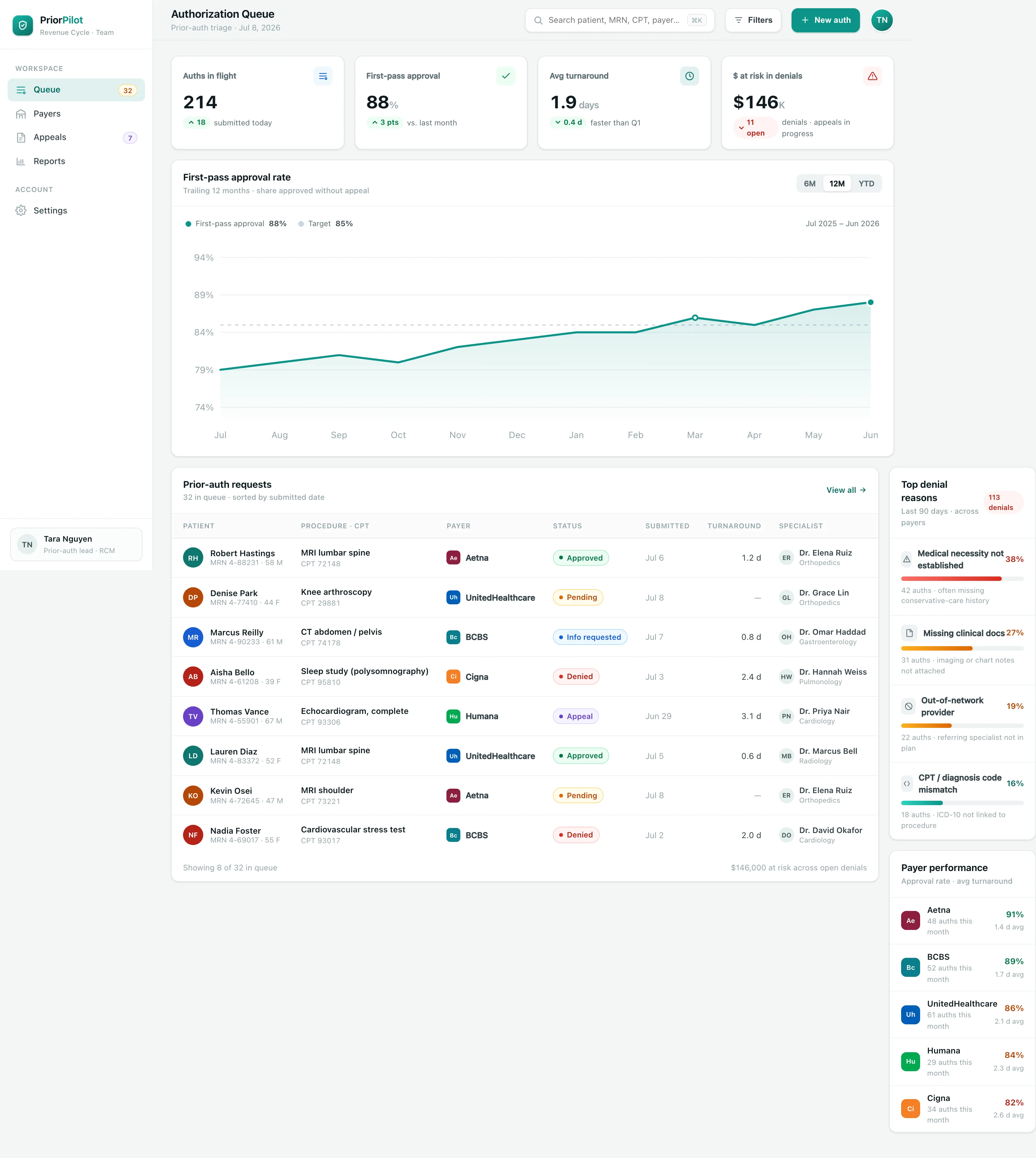
PriorPilot
An AI prior-authorization and denial-management platform that auto-assembles and submits auths, predicts denials before submission, and drafts the appeals to recover revenue.
Healthcare AI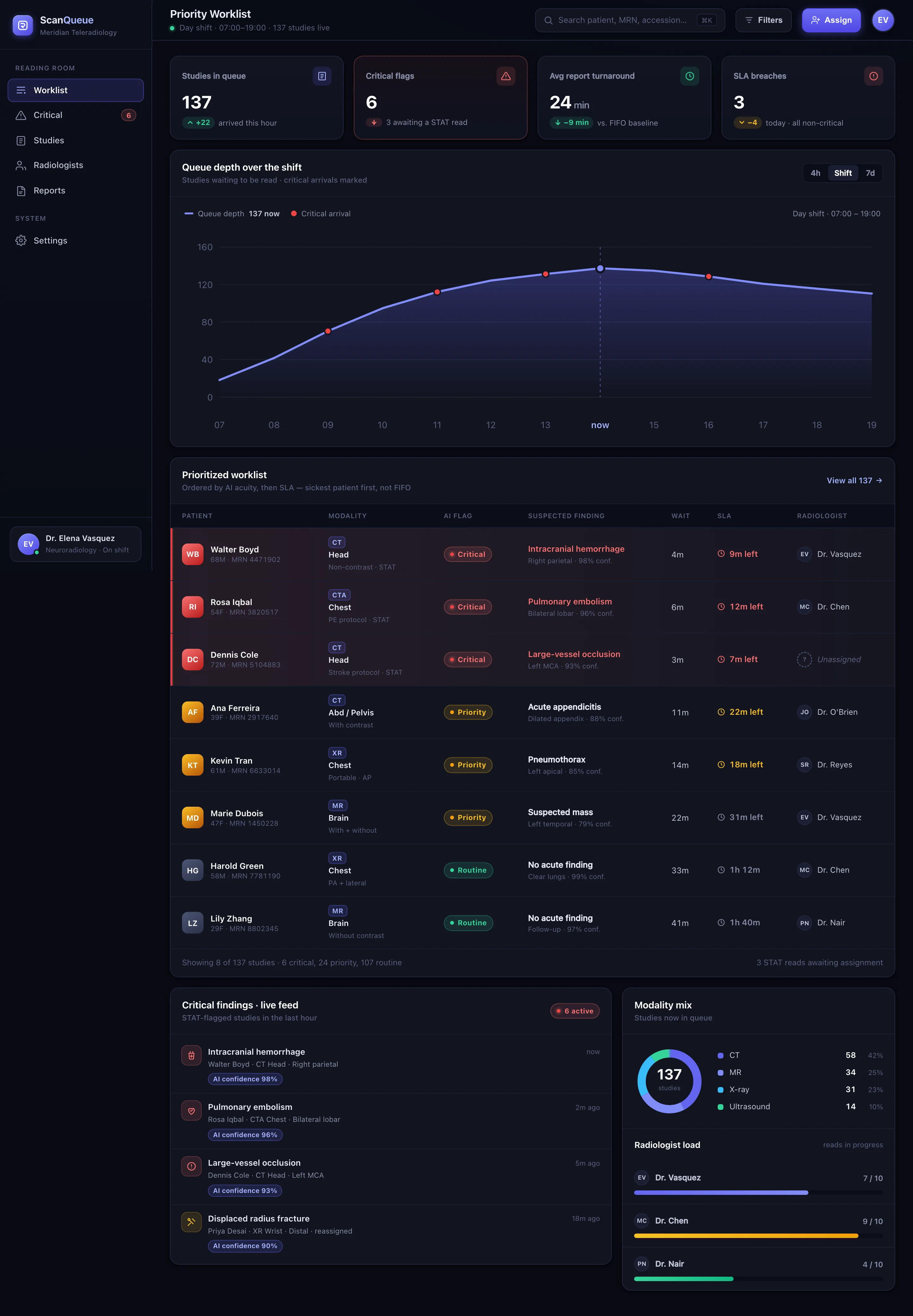
ScanQueue
An AI radiology worklist that flags suspected critical findings on incoming CT, MR and X-ray studies and orders every read by acuity and SLA — so the sickest patient is read first, not FIFO.
Healthcare AI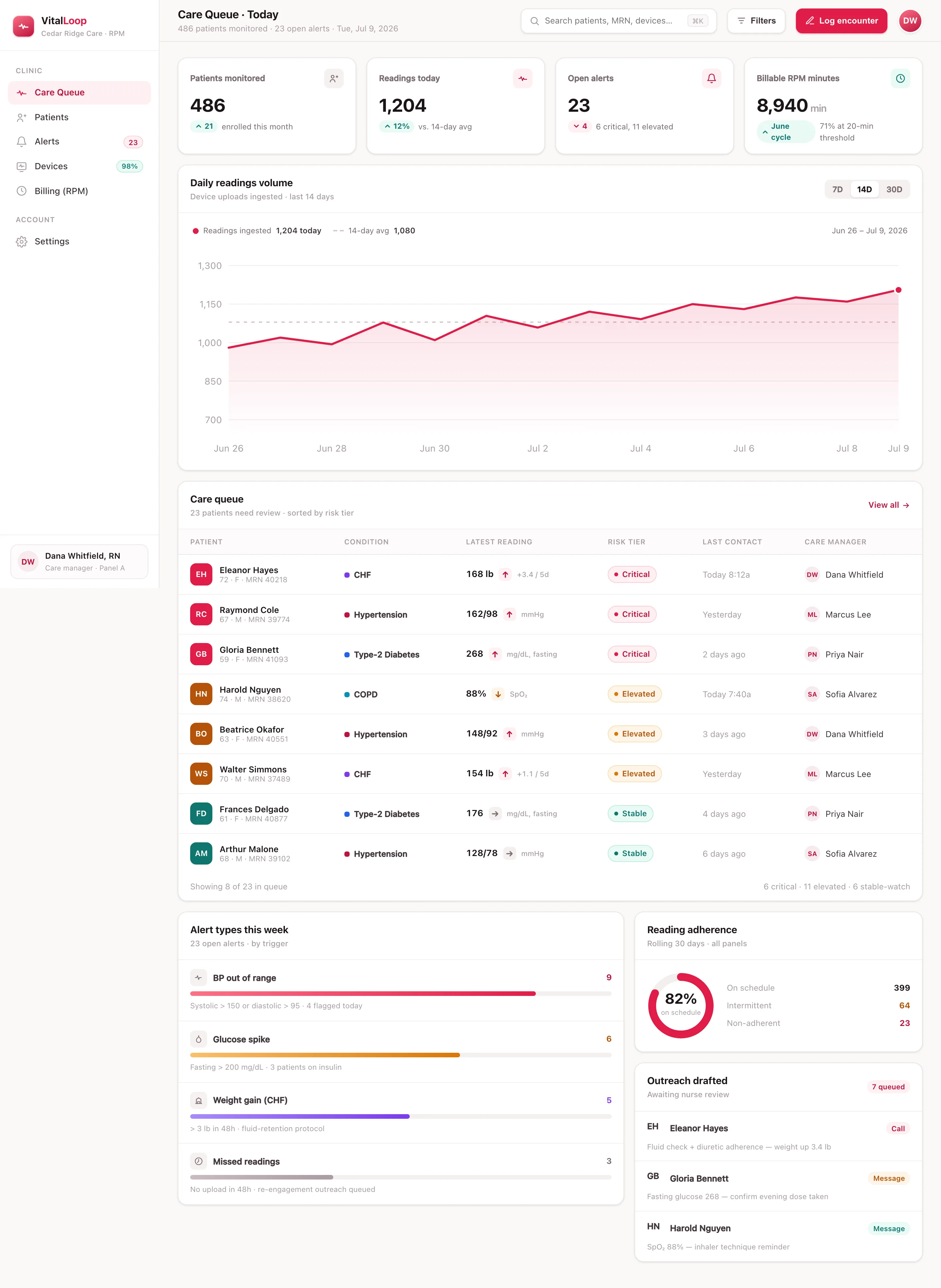
VitalLoop
An AI remote patient monitoring platform that triages home vitals into a prioritized care queue, drafts patient outreach, and tracks billable RPM minutes.
Healthcare AIIndustries this applies to
Read next
- Private and on-premises LLM deployment for regulated industriesNot every compliance requirement means self-hosting a model. Here are the four real options, ordered by cost and control, and how to work out which one your constraint actually demands.4 min
- How to scope an AI project so it actually shipsAI projects rarely die from a hard engineering problem. They die from a scope that was never testable in the first place. Here is a method for writing one that is.4 min
- From AI proof of concept to production: what the gap actually containsThe prototype impressed everyone in the room and then nothing happened for eight months. That gap has a predictable content, and almost none of it is model quality.4 min
Working on something in this space?
Tell us where you are in a sentence or two. We'll tell you honestly whether we're the right team, and what a sensible first slice of the work looks like.
Start the conversation