AI for customer support: deflection without wrecking satisfaction
In short
Deploy support AI in the order of increasing risk: triage and routing first, then drafted replies an agent edits, then knowledge grounded in your own documentation, and only then customer-facing autonomous resolution on narrow, well-understood intents. Optimising for deflection rate alone reliably degrades both satisfaction and cost.
Support is the most attempted AI use case in software, and the one with the most visible failures. The reason is usually a metric: teams deploy a customer-facing bot and measure deflection, which rewards not answering the question as much as answering it.
A customer who abandons a chat in frustration counts as deflected. So does one who gets a wrong answer and comes back angry two days later — often twice, since the second contact is a new ticket. Deflection alone will make your dashboard improve while your operation gets worse.
Deflection counts the conversations that ended. It does not distinguish between the ones you resolved and the ones you exhausted.
A rollout order that works
Sequence by risk. Each stage earns the trust and the data for the next, and every one of them is useful on its own.
Stage 1 — Triage and routing
Classify inbound tickets by intent, urgency, sentiment, and the team that should own them. No customer ever sees the output, so a misclassification costs a re-route rather than a bad experience.
This is where most of the immediate return sits, because misrouting is quietly expensive: it burns the first-response clock, drags a second agent in, and is a leading cause of breached service levels. Support Pulse does this for SaaS support teams — triaging tickets and drafting replies to cut first-response time and stop service-level leaks.
Stage 2 — Drafted replies the agent edits
The system writes a suggested response; the agent reviews, edits, and sends. The human checkpoint already exists, so nothing reaches a customer unreviewed.
This stage produces something valuable beyond the time saved: every edit is a labelled correction. The gap between the draft and what the agent actually sent is the highest-quality evaluation data you will ever get, and it arrives for free. Capture it from day one — it is the backbone of the harness described in LLM evaluation in practice.
Stage 3 — Grounded answers from your own documentation
Now let the system answer from your actual knowledge base, with citations, so agents and customers can verify what it said. The critical constraint is grounding: the answer must come from retrieved documentation, and the system must decline when the documentation does not cover the question.
A support assistant that will not say "I do not have that documented" is worse than no assistant, because it converts a known gap into a confident wrong answer. Building this well is a retrieval problem more than a generation one — see RAG vs fine-tuning.
Stage 4 — Autonomous resolution, narrowly
Only now, and only for intents where stage two showed a high acceptance rate, the answer is stable, and the failure is recoverable. Order status, password resets, plan changes, documented how-tos.
- Start with a small, explicitly enumerated set of intents. Everything else routes to a human, immediately and without a fight.
- Make escalation one obvious click, always visible. Hiding it is what generates the worst experiences and the worst reviews.
- Pass the full conversation to the agent on escalation. Making a frustrated customer repeat themselves is the single most damaging thing a support bot does.
- Track resolution confirmed by the customer, not conversations ended.
Measure these instead of deflection
| Metric | What it tells you |
|---|---|
| Draft acceptance rate by intent | Which categories are ready for more autonomy |
| Reopen rate within 7 days | Whether "resolved" was real |
| Escalation rate after AI contact | Whether the first attempt helped or delayed |
| Repeat contacts on the same issue | The clearest signal of a wrong answer |
| Satisfaction split: AI-touched vs not | The trade you are actually making |
| First response time | The metric triage moves fastest |
The adjacent wins people miss
Support data is one of the richest unstructured datasets a company has, and most of the value in it is not about answering tickets faster.
- Clustering tickets by root cause tells product what to fix. This routinely outperforms deflection on cost, because a fixed bug removes the tickets permanently.
- Gaps between what customers ask and what your documentation covers form a prioritised content backlog. AskVault surfaces exactly these gaps from internal knowledge search.
- Support signals are strong churn predictors — sentiment trends, contact frequency, and unresolved escalations. That is the premise behind Churn Radar, which flags at-risk B2B accounts and prescribes the save play.
More on how we approach this space on the SaaS and customer support page.
Frequently asked questions
Short answers to the follow-ups this piece tends to raise.
How do I use AI in customer support without hurting satisfaction?
Sequence by risk. Start with triage and routing that no customer sees, then drafted replies an agent edits before sending, then answers grounded in your own documentation with citations, and only then autonomous resolution on a narrow, enumerated set of intents where drafts already show a high acceptance rate.
Why is deflection rate a bad metric for support AI?
Because it counts conversations that ended, not problems that were solved. A customer who abandons a chat in frustration counts as deflected, as does one who receives a wrong answer and returns days later as a new ticket. Track reopen rate, escalation rate after AI contact, repeat contacts, and satisfaction split by whether AI touched the ticket.
What is the best first AI project for a support team?
Ticket triage and routing. No customer sees the output so a misclassification costs a re-route rather than a bad experience, and misrouting is quietly expensive — it burns the first-response clock, pulls in a second agent, and is a leading cause of breached service levels.
How do agent-drafted replies improve the system over time?
Every edit an agent makes is a labelled correction. The difference between the draft and what was actually sent is the highest-quality evaluation data available, and it accumulates automatically as a by-product of normal work. Capture it from the first day.
- customer support
- SaaS
- automation
- industry
The work behind this article
Builds from our portfolio that this piece draws on.
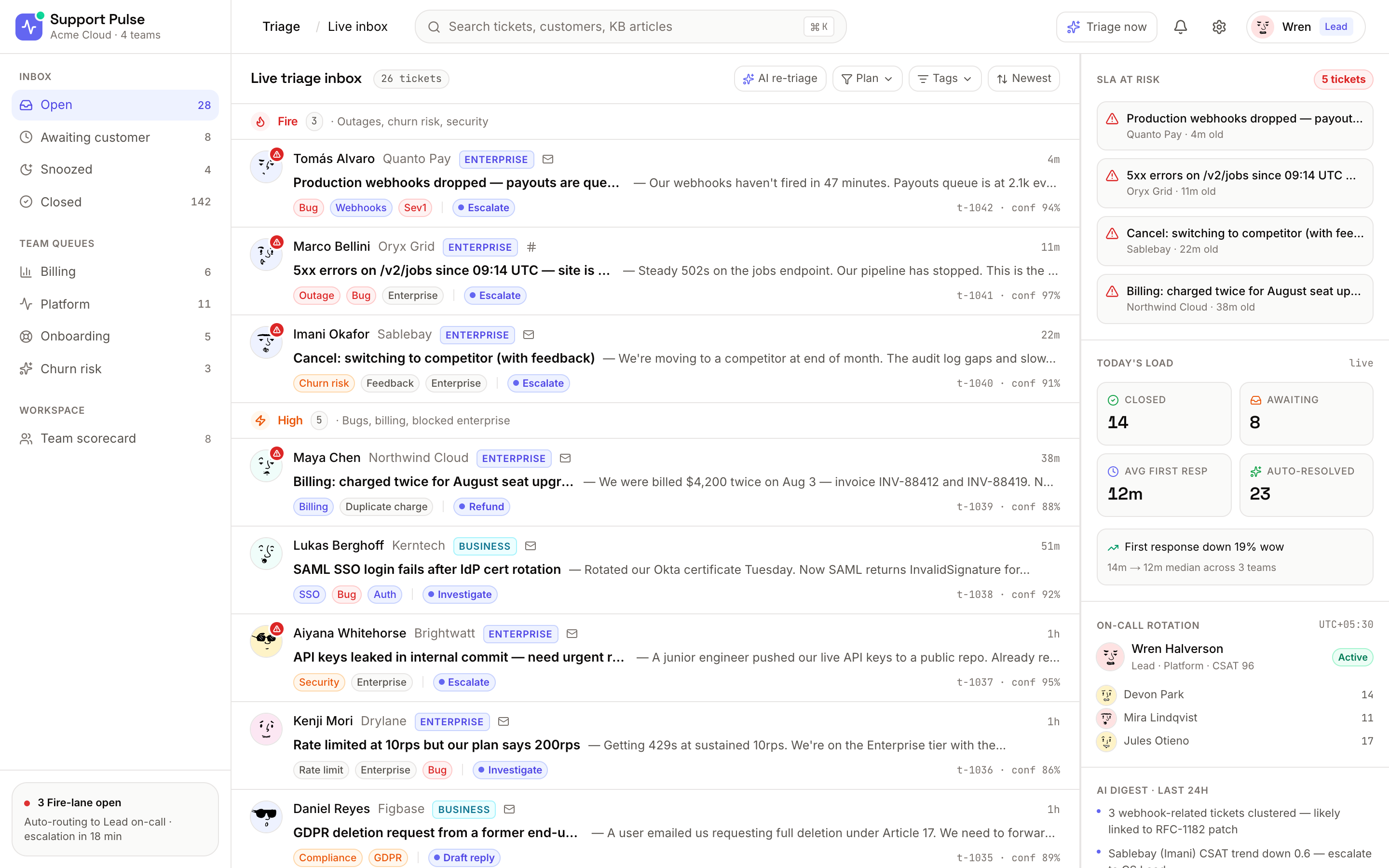
Support Pulse
AI ticket triage and drafted replies for SaaS support teams — cut first response time and stop SLA leaks.
SaaS Tools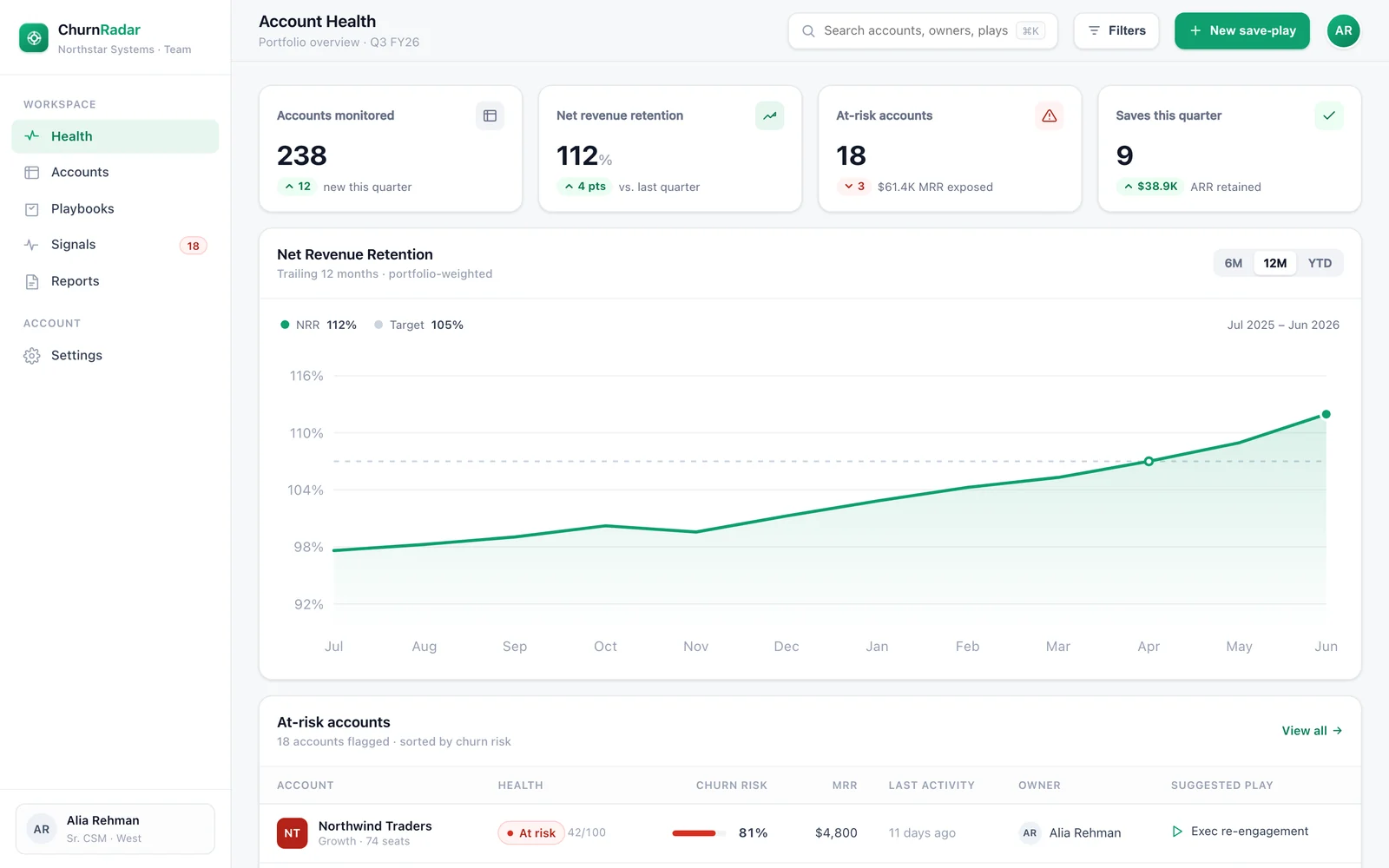
Churn Radar
An AI customer-success platform that flags at-risk B2B accounts before they churn and prescribes the save-play to run.
Customer Success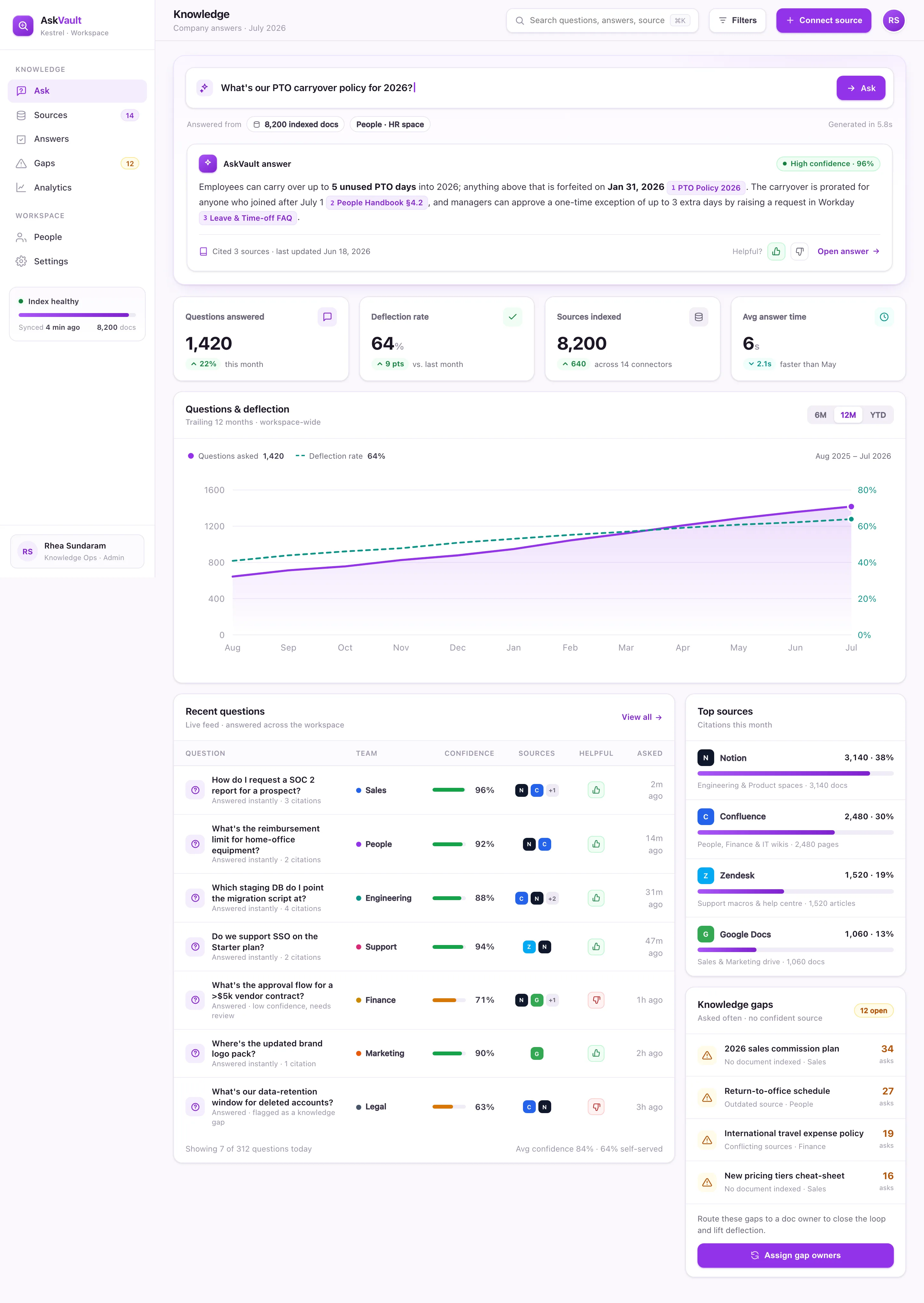
AskVault
An AI internal knowledge-search platform that answers employee questions from your own docs — grounded in citations, with knowledge gaps surfaced and deflection tracked.
Productivity AI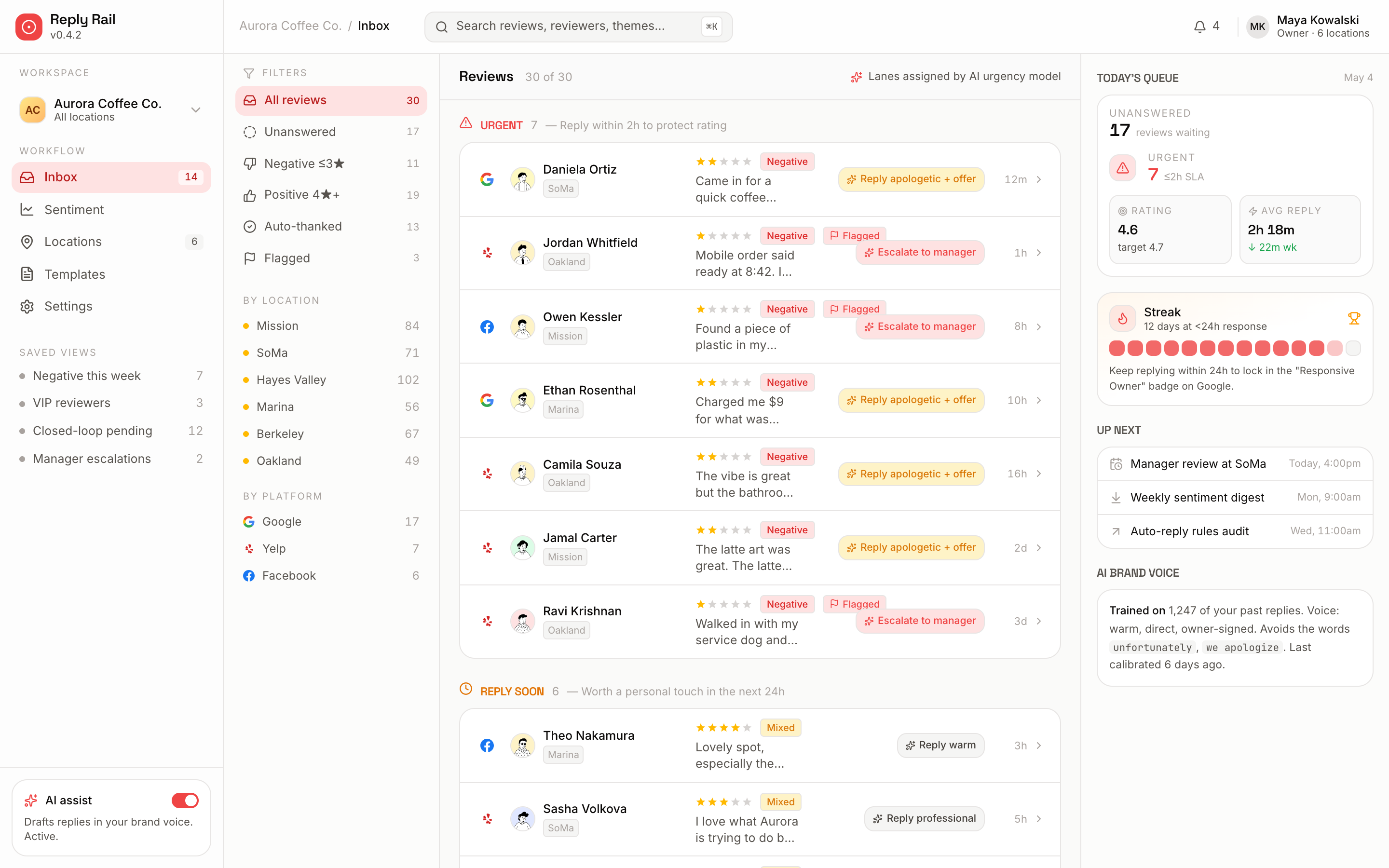
Reply Rail
AI-drafted Google, Yelp, and Facebook review responses for local businesses — one queue, one click.
Local Business AIIndustries this applies to
Read next
- LLM evaluation in practice: how to know your AI feature actually worksWithout evaluation, every prompt change is a guess and every regression is invisible until a customer finds it. Here is how to build a harness that is small enough to actually maintain.4 min
- RAG vs fine-tuning: which one does your use case actually need?The question is usually posed as a choice between two techniques. It is better understood as a diagnosis: is the model missing knowledge, or missing behaviour?4 min
- AI agents in production: what actually breaksAn agent that works in a demo and an agent that runs unattended against real systems are different engineering problems. These are the failures that show up in week three.5 min
Working on something in this space?
Tell us where you are in a sentence or two. We'll tell you honestly whether we're the right team, and what a sensible first slice of the work looks like.
Start the conversation